Buying a Water Filter? These 5 Mistakes Cost Australian Families Hundreds

If you have started looking into water filters, you have probably had the 11pm thought that goes with it: is our tap water actually a problem, or am I overthinking this?
Even the regulators took two years to answer that. In June 2025 Australia's National Health and Medical Research Council set new, significantly lower PFAS limits for drinking water. The standard itself moved.
So you are not overthinking it. But most people buy the wrong filter first. Here are the five mistakes, and a check for each.

1. Paying for a filter that only fixes the taste
The $60 jug in the fridge does something real: activated carbon improves taste and smell, so the chlorine flavour fades.
But the things people actually worry about, PFAS, heavy metals and microplastics, are dissolved at a scale a carbon jug was never built for. They pass straight through to your glass, tasting better on the way. You cannot taste PFAS, which means you cannot taste whether your filter is working.
Bottled water is not the way around it either. A 2024 Columbia University study published in PNAS found that a single litre of bottled water carries around 240,000 plastic fragments. Per litre, not per bottle.
That is the job reverse osmosis was built for: water is forced through a membrane so fine that dissolved substances are rejected and flushed away.
THE CHECK: ask not "does it improve the water?" but "what does it physically remove, and how?" A taste and odour answer means a taste product.

2. Sacrificing the whole cupboard to an old style tank system
If you have looked into reverse osmosis and gone cold on it, it was probably the photo: a pressurised tank and a nest of tubing swallowing the whole cupboard. Plenty of systems still work that way.
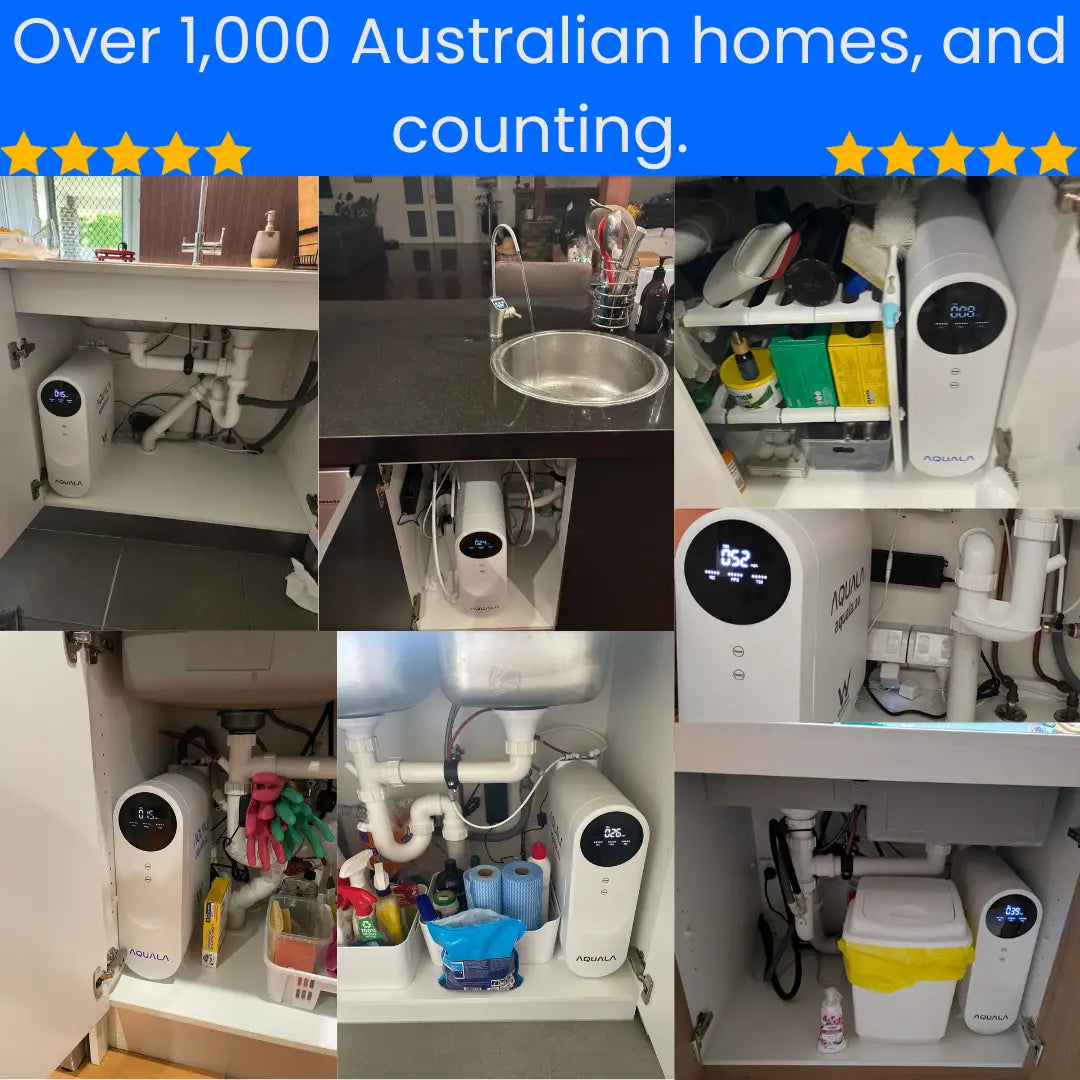
Old membranes filtered slowly, so those systems made water in advance and stored it in a plastic tank, where it sat for hours before you drank it. A tankless system pairs a faster membrane with a pump and makes your water the moment you open the tap. Nothing is stored, and the unit is about the size of a shoebox on its side.
One verified five-star reviewer put it plainly: "Tankless system takes up hardly any space and the water doesn't sit in yucky plastic."
THE CHECK: ask whether the system stores filtered water in a tank, and for how long. Then measure your cupboard.

3.Buying a system that strips everything out, including the good stuff
Reverse osmosis has one fair criticism: a membrane that fine does not discriminate. Along with the contaminants it removes the calcium and magnesium that give good water its taste, which is why water from older systems gets called flat, or stripped.
The fix already exists. A modern system runs the water through a remineralisation stage after the membrane, putting those minerals back: the nasties removed, and the taste water is supposed to have.
THE CHECK: look for a remineralisation stage on the spec sheet, sometimes called alkaline or mineral boost. Plenty of systems skip it.

4. Doing the maths on the sticker price, and nothing else
Every way of getting drinking water has two prices: the one you pay up front, and the one you keep paying.
Bottled water is the extreme case. Branded 24-packs work out at around a dollar a litre, and a family of four drinking the recommended daily amounts goes through more than 40 litres a week. That is around $2,000 a year, every year, plus the hauling and the plastic. The cheapest home-brand slabs only bring it down to about $1,500.
An under-sink system reverses that shape: more up front, then two running numbers. Cartridges for a tankless system like the P500 cost around $295 a year, about 80 cents a day for a family's unlimited filtered water. And the waste ratio: older systems commonly send three or four litres to the drain per filtered litre, where the AQUALA tankless design runs closer to 2:1.
THE CHECK: ask the seller for three numbers in writing. Cartridge cost per year, waste ratio, and what installation involves. A vague answer is your answer.

5. Buying a system no Australian plumber is allowed to install
Search "tankless reverse osmosis" online and you will find units from $700 to $2,000 that look nearly identical. The difference that matters is WaterMark, Australia's mandatory standard for anything that connects to your plumbing. Many imported systems sold through online marketplaces carry none.
That matters even if you were never going to hire a plumber. A licensed professional is legally prohibited from installing an uncertified unit where certification is required. And if one leaks through your cabinetry the problem lands on you, whoever installed it: an insurer can decline a water-damage claim over non-compliant fittings.
THE CHECK: ask for the WaterMark licence number and look it up on the ABCB register before you buy.

You can run all five checks yourself. A membrane, not just carbon. Tankless, not a tank. Minerals put back in. Running costs in writing. A licence number you can look up tonight.
We built the AQUALA P500 to pass all five, after 28 years of commercial water engineering where the water has to be right every day.
The AQUALA P500 tankless reverse osmosis system is $999, was $1,400. You save $401, and shipping is free. Less than a year of bottled water, once.
It is WaterMark certified (licence WM-032256, on the ABCB register), with a 30-day money-back guarantee.


P500 Tankless Reverse Osmosis System
P500 Tankless Reverse Osmosis System
Pre-order now. Ships October 15th.